In Short: What is the Microsoft Fabric pricing model ?
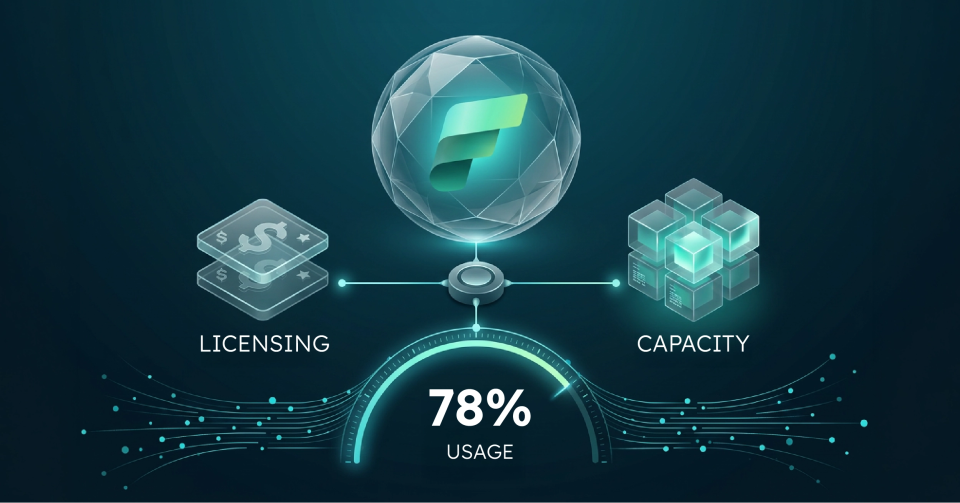
Microsoft Fabric pricing is built on two primary levers:
1. Capacity(compute): You purchase an F - SKU(F2, F4, … F2048) that provides a pool of Capacity Units(CUs) your Fabric workloads consume.Fabric capacity is designed to be scalable, with controls to monitor and manage usage and cost. 2. Licensing(people): Fabric “who can create / share / consume” depends on a combination of capacity + per - user licenses.Fabric licensing and capacities determine how users create, share, and view items across the organization.
The real story isn’t “what’s the monthly number ?” It’s that Fabric prices the operating model: shared compute + governed collaboration: and your spend follows usage patterns and concurrency, not just data volume.
Why does understanding Fabric cost matter ?
Most organizations don’t overspend on analytics because they’re wasteful; they overspend because they don’t measure the right thing.
If your platform is a mix of separate tools per team, duplicated pipelines, competing semantic models, and refresh chaos, then cost becomes a byproduct of fragmentation: not a managed decision.
Fabric can absolutely reduce the “complexity tax,” but only if you understand how it bills and how consumption is calculated.
What do you pay for in Microsoft Fabric ?
1) Fabric Capacity(F - SKUs)
Fabric “runs on a capacity,” which is a pool of compute resources.Each F - SKU maps directly to how many CUs you have available.Microsoft’s capacity planning guidance includes a clear table: for example, F64 = 64 CUs, F128 = 128 CUs, etc.
You then choose how you buy that capacity:
- Pay - as - you - go for flexibility.
- 1 - year or 3 - year reservations for discounted, predictable spend(Microsoft highlights savings of ~41 % compared to pay - as - you - go).
2) Licensing(Who Can Do What)
Licensing is where most Fabric rollouts either scale smoothly or become an internal tax.Microsoft’s guidance is explicit: Fabric uses licenses and capacities together to define how users create, share, and view items.
For collaboration scenarios, you typically need an F or P capacity plus at least one per - user license, depending on your scenario and workspace / license mode.In practice, Capacity is the engine while per - user licenses are the keys.
Compare Fabric, Synapse, and Power BI licensing models here.
How is Microsoft Fabric usage measured ?
The Unit That Matters: Capacity Units(CUs)
Fabric measures compute consumption using Capacity Units (CUs).The most important operational detail: consumption is evaluated in a 30 - second window.
Microsoft’s capacity planning guidance states that the Capacity Metrics App uses the same 30 - second evaluation period the platform uses to measure consumption.To translate a SKU into its “30 - second budget,” multiply CUs by 30(for example, F64 equates to a budget of 1920 CU every 30 seconds).
What does 30 - second measurement mean in plain language ?
You aren’t paying “per dashboard” or “per pipeline.” You’re paying for how much work happens, how often it happens, and how many things happen at the same time(concurrency).
Two companies with the same data size can have totally different costs if one has:
- Aggressive refresh schedules
- Heavy background pipelines
- Inefficient semantic models
- Competing workloads on the same shared capacity
Which tool makes Fabric usage visible ?
Microsoft provides the Microsoft Fabric Capacity Metrics app to monitor capacity consumption and help you make decisions like when to scale up or when to enable autoscale.The compute page guidance also explains how the app presents performance and utilization, including utilization visuals and system events.
What business problems does this pricing model solve ?
1. It Turns Analytics Cost Into a Single Managed Dial : A shared capacity model can replace a scatter of disconnected compute engines and makes it possible to manage spend as a platform product, not a set of tool invoices. 2. It Makes Performance and Cost a Governance Topic : Because usage is measurable(30 - second evaluation) and observable(metrics app), you can treat cost as an operational KPI: not a finance shock. 3. It Gives You Real Cost - Control Options : Microsoft highlights platform controls to monitor and manage costs, and pricing options like reservations for long - running production loads.
Who is this pricing guide for?
This topic becomes urgent if you are:
- Moving from legacy BI / data warehousing to Fabric.
- Planning enterprise - wide Power BI + Data Engineering + Warehouse workloads.
- Scaling usage across departments(concurrency growth).
- Building governed data foundations to support AI initiatives.
What is the strategic point most organizations miss ?
Fabric capacity is shared.That means your biggest cost risk isn’t the SKU itself: it’s how the organization behaves on that SKU.
The organizations that win with Fabric define:
- Which workloads are “production critical” vs “background.”
- Who owns refresh frequency and semantic model sprawl.
- How teams are isolated inside the capacity.
- What “acceptable consumption” looks like for each domain.
In other words: the platform matters, but the operating model matters more.
Why work with Solv Systems on Fabric cost ?
At Solv Systems, we approach Fabric cost as an engineering and governance outcome, not a licensing spreadsheet exercise.
Strategy Before Architecture
We start with the decisions the business needs to make, the latency expectations(near real - time vs daily), and the adoption model(self - service vs managed reporting).Then we align capacity and licensing to that reality.
Capacity Sizing That Matches Reality
We size using Microsoft’s consumption model: CU-based planning, 30 - second evaluation behavior, and Metrics App instrumentation to validate real workloads before scaling.
Governance That Prevents “Noisy Neighbor” Spend
We implement platform guardrails so one team’s experimentation doesn’t throttle everyone’s reporting, background jobs don’t starve interactive workloads, and usage patterns are explainable and fixable.
A Practical Path to Predictable Monthly Cost
We help you choose when pay - as - you - go is the right lever for variable environments and when reservations are the right lever for steady production to reduce cost.